

Trophies:
Premier League, FA Cup, EFL Cup, Community Shield
Country:
England
City:
Leicester
League:
EFL Championship
Stadium:
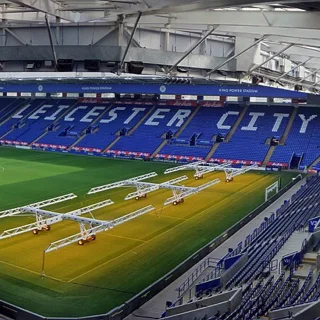
King Power Stadium
Founded:
1884
Main Colors:
Blue, White
Leicester City Football Club was founded in 1884 as Leicester Fosse by a group of former pupils of Wyggeston School. The club initially played at several grounds before settling at Filbert Street in 1891, a stadium that would remain its home for more than a century. Leicester joined the Football League in 1894 and adopted the name Leicester City in 1919, following the granting of city status.
The club spent much of its early history moving between the top two divisions of English football. One of its strongest pre-war campaigns came in 1928/29, when Leicester finished second in the First Division. Arthur Chandler was the outstanding goalscorer of the period and became the club’s record league scorer. Major silverware, however, remained elusive for several decades.
Leicester City developed a notable cup tradition after the Second World War. They reached the FA Cup final in 1949, 1961, 1963 and 1969 but lost on each occasion. League Cup competition brought greater success. Leicester defeated Stoke City over two legs to win the trophy in 1964 and reached the final again the following season, losing to Chelsea.
The 1990s produced another successful period under manager Martin O’Neill. Leicester won promotion to the Premier League through the play-offs in 1996 and established themselves in the top flight. They defeated Middlesbrough after a replay to win the League Cup in 1997, then captured the competition again in 2000 with a 2-1 victory over Tranmere Rovers at Wembley. Players including Matt Elliott, Muzzy Izzet, Neil Lennon and Emile Heskey were prominent during this period.
The club left Filbert Street in 2002 and moved to a new stadium, initially known as the Walkers Stadium and later renamed King Power Stadium. Financial problems accompanied the transition, and Leicester City entered administration during the 2002/03 season. Further difficulties eventually led to relegation to the third tier in 2008 for the first time in the club’s history. Nigel Pearson guided Leicester back to the Championship at the first attempt.
Leicester returned to the Premier League as Championship winners in 2014. Their first season back ended with an extraordinary escape from relegation after seven victories in their final nine league matches. Claudio Ranieri replaced Pearson as manager in July 2015, beginning the most famous season in Leicester City’s history.
With Jamie Vardy scoring 24 league goals and Riyad Mahrez named PFA Players’ Player of the Year, Leicester transformed from relegation candidates into title challengers. N’Golo Kante, Kasper Schmeichel, Wes Morgan and Danny Drinkwater were also central to the team. Leicester secured the 2015/16 Premier League championship after Tottenham Hotspur drew with Chelsea on 2 May 2016. The club finished ten points ahead of Arsenal, winning the English top-flight title for the first time.
That championship took Leicester City into the Champions League for the first time. They won their group and eliminated Sevilla before losing to Atletico Madrid in the 2016/17 quarter-finals. In October 2018, tragedy struck when a helicopter carrying chairman Vichai Srivaddhanaprabha crashed outside King Power Stadium following a match against West Ham United. Srivaddhanaprabha and four other people were killed.
Under Brendan Rodgers, Leicester City returned to the upper reaches of the Premier League and finally won the FA Cup in 2021. Youri Tielemans scored the only goal as they defeated Chelsea 1-0 at Wembley, ending the club’s record of four previous defeats in FA Cup finals. Three months later, Leicester beat Manchester City 1-0 to win the FA Community Shield.
Leicester City reached the UEFA Conference League semi-finals in 2022 but suffered relegation from the Premier League the following year. Enzo Maresca led an immediate recovery, with Leicester winning the Championship in 2023/24 and returning to the top flight. The stay lasted only one season, and relegation in 2025 returned the club to the Championship.
The 2025/26 campaign brought further disruption, including a six-point deduction for breaching EFL financial rules. Leicester finished the season in the Championship play-off places but missed promotion after losing their semi-final. The points sanction and its effect on the promotion race added another significant chapter to a modern history that has moved between a Premier League title, domestic cups, European football and repeated battles to regain top-flight status.